Monday, December 10, 2012

Man’s Imagination


God once  upon a time, long ago, cut the imagination out of man’s mind
       for one day and one night, I am told, thus, he found—that is,  man found, he could now rest more easily, sleep more deeply, and he no
       longer ran like a rabbit after his sexual wishes, desires, and needs. He no longer moped with a lowered jaw. His gravitational field had a
       better balance. But a problem appeared, as if out of nowhere, he rolled over like a dog: over and over and over, as if he was searching
       for something long lost. He got bruised and bloodied as if torn to pieces by thorn bushes; hence, he started to weep, unable to replace
       this loss. And so, at the end of one day and one night, God gave back to man, once again, his Imagination.

#3481 (12-5-2012)
  

Haiku for: the Happy Muslim


I’m: Happy, happy!
Even if I look sad, sad!
Or really: mad, mad!

#3433 (9-27-2012)

False Outrage


(Seal of the Muslim)


The Film “Innocence of Muslims,” by M. Zuckerbergt,
       equates Islam with Violence,
And what did Islam do? It committed acts of Violence,
       killing J.C. Stevens, American diplomat, and
His entourage: point made, Mark Zuckerbergt—and
       who gets the blame?
How about: free speech, which isn’t free according to
       Islamic theology
And the culprits who did the evil dead goes free; what
       does that say about Islam?
Evil begets evil? Perhaps Islam inspires evil or
       atrocious acts: and instead of giving an elegy
They would rather have an apology: an old satanic trick,
       oil the squeaky wheel—thus, evil triumphed…
Over good. Perhaps it is better to let them live under
        ‘dominate force’ (that is to say: whoever dominates
Them, controls them, will triumph over them, it is how
       it has always been).
Forget democracy, because freedom of speech, with
       them, will never be—free.
It is either that, or retreat. America must learn, not all
       humanity, yearns for liberation!
Nor is it our duty to advance it, nor can we command it.
What next will the Muslim do? The Devil knows and he’s not
       saying.
Let the wise man study the Middle East, hope he learns,
       they have an aversion to freedom:
Especially America’s version or definition…

#3433 (9-25-2012)

Darkness Below the Sphinx


((1998, Egypt) (Short Version))


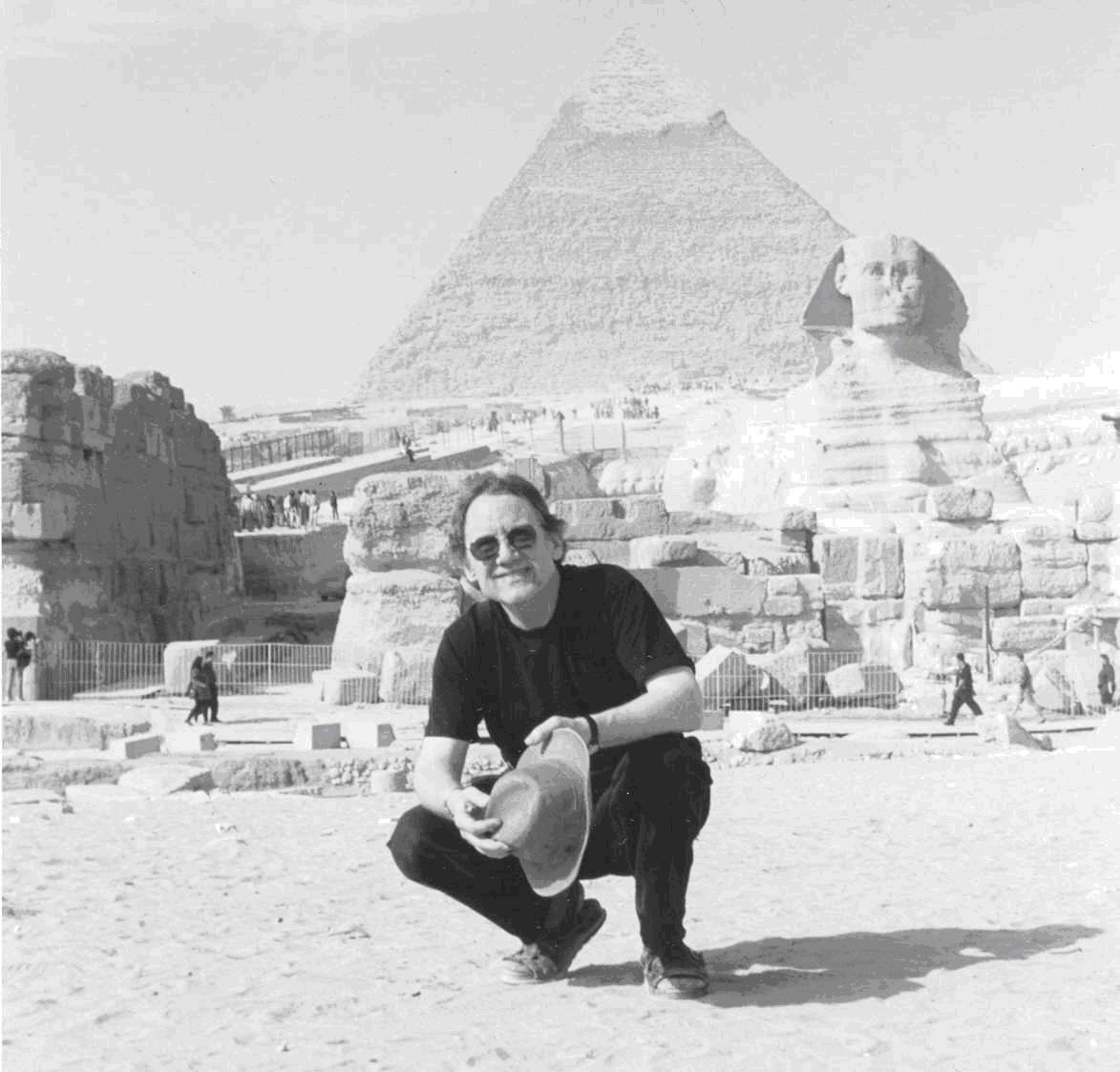
The Poet, Author, in Egypt, 1998


It was late and every one had left the outside seating area who had been watching the illumination show of the Pyramids, and Sphinx, except a hired guide given me by Solomon: the Captain of the Bellboys, at the Sheraton Hotel, in Cairo, and a hired policeman, who guarded the Sphinx, whom I paid well, a middle aged man, as was Solomon and the guide—all paid well to take me after the show to see the Sphinx—and there I waited in the shadow of the building, the Sphinx in the darkness in front of the building beyond the dirt road that lead to the plateau, and there I waited, against the electric light that appeared to be on permanently.


       In the daytime the dirt road in front of the building and seating area overlooks the Giza Plateau, in that it is visible—where the Great Pyramid is—now closed for repairs, in which I had to go to the Khafra Pyramid in place of the Khufu Pyramid, the Sphinx being in front of the pyramid, and causeway, the street was dusty, but during the evening dew had settled the dust and now as it was close to midnight, it was quiet and the heat of the day was cooled, and one could feel the difference.
       The guide and the policeman were friends of Solomon the Arab, all three were Arabs, and while he knew the two were good contacts and associates, and took me as a client, paying only the policeman (and themselves), without paying the soldiers that guarded the Sphinx, so they’d allow me to visit the Sphinx after midnight in person —actually forbidden.
        ‘Don’t utter a word during the visit…’ said Solomon, after he had dressed me in a white tunic, and head-covering, hiding my Irish-American look.

       “Now don’t say a word,” said the policeman—repeating what Solomon had said, meaning: be quiet there are guards down there—soldiers, “we didn’t pay the soldiers, so we don’t want any trouble with them!”  
       He looked—as he talked—with a slight showing of despair within his eyes, and around the corners of his mouth, then told another Arab that came out of the dark, to take me down to the Sphinx’s enclosure, and in-between its arm.

       And there I was.
       We stood together, a full moon overlooking the head of the Sphinx, then I got closer—as he remained at the paws of the Sphinx, venturing inward towards the large stone plaque in its center with its ancient writings, then I found myself against the wall of the arm, and looked for a spot to climb up, found one and pushed upward three feet or so, and the Arab whispered, more than a whisper, a hiss:
       “No..oooo, you can’t climb i…T!”
       I was already a few feet up, I jumped back down—there was a thump, he held his breath, “Why not?” I asked.
       “Be quiet, we don’t want to alert the soldiers,” he prayed.
       Nothing seemed to move, not even a slight wind; with the light of the moon, and the few stars: the Sphinx was seemingly looking down on me as if it had a demon inside its rock riddled carcass, as if it was awaiting a storm. I even visualized Seth: the ancient Egyptian deity of storm and turmoil, as if he was gawking at me through this representation of the head of Khaf-Ra, —as if he wanted to pull out his legendary wings, move that robust lion’s body, and devour me, or its legs crush me.

       A streetlight shown in the far back, gave, a little light in that I could see the Arab didn’t wear a head covering.
       From the start to this point he was constantly trying to hurry me.
       I pulled a chip of stone from the side of the Sphinx, put it in my pocket, then I took my camera and took a picture, why I did this, I don’t know, I just don’t know—no excuse for it, but the light flashed—with a swell effect throughout the whole plateau, and the Arab was feeling worse for it every second, put his hands over his face, bending over as if not wanting to be noticed, crouching like a dead vulture.
       For a moment there was no communication between us—then he said, disappointed, and disapprovingly, said—pointing, with his hand and finger, and stretched out arm, pointing the way back, the same way we came in: “Now,” he began, “now we finish…, we go, go… please, please we go! Everybody sees!” he was scared, real scared, scared as if the hounds of hell were going to be upon him.
       He did not wish to be rude, but he was terrified and so the tone of his voice showed it, and thus, it just came out that way, and I was not seemingly in a hurry—as I should have been, but I left because of his panic— heretofore, I felt indifferent, not really in any danger. And as we started to walk back towards the Policeman, —perhaps feeling he had talked too loud if not too much, because he was now mumbling in a near whisper, and kept on saying:
       “You d not un-er-stand da light…da light…bad…!” nearly inaudible, as I patiently followed him with my eyes; hence, I felt an impulse of apprehension creeping up my legs, spine, the hair of my arms, goose-bumps.

       Now I heard footsteps, coming out of the dark, towards me and the policeman—someone had seen the flash, and my guide who was waiting, and the Arab that had shown me the Sphinx, he was long gone, as if he had disappeared into thin air, and I could see an unhappiness on the mouth of the policeman; what was he thinking? I, at that point was unaware just how costly that flash could be—that it would take an act of God’s intervention to settle what was going to take place.

       “Certainly you do not want trouble…” said the policeman, who spoke better English than the Arab who took me to the Sphinx, although I am giving him the benefit of a doubt here, “You should not have flashed your camera!” and he wasn’t kidding.
       What went through my mind was: what did he fear? I mean it all could be explained, yet there was that fear or dread. Then a soldier appeared, came up and out of the dark, evidently behind the shadow of the back of the Sphinx, with an automatic rifle pointing it at me. Consequently, I woke up, cooled and awakened to the ache of trouble.
       Some words were said, and then the policeman told me abrupt and perhaps a little obvious:
       “He wants me to give you to him, but I know if I do, he’ll take you out behind the plateau and kill you, and no one will find you ever again—; he disapproves of you being here, resents me for allowing it without notifying him.”
       And then the soldier, a youth perhaps twenty-three years old, an Egyptian in military black garb, grabbed my wrist fiercely, and started pulling me towards him, and the Policeman grabbed my other arm pulling me his way—the opposite way, then the guide ran away in a cowardly fashion—he would ask me later on that evening, halfway down the dirt road: not to tell Solomon about his cowardly behavior. He was the one who had done some of the arrangements, announced to the Policeman that Solomon had arranged this, paid him.
       And there he was, the soldier:
       “Give me this person,” the soldier must have said, demanded, from the look on his face and sound and tone of his voice. And my arms were being pulled every-which-way—both ways, stretched to the limit—until my arms ached, neither one giving up, emotionally too.
       I didn’t say a word, I stood erect without a smile, with a dull stream of strain, knowing one or the other was going to win this tug-of-war, and if it was the soldier I was dead.  Oh, yes, dead buried in some sand heap, or mound, behind the Sphinx or Pyramids, or out in the desert long forgotten—oh, I was sure the policeman was not teasing me—to the contrary: for on the soldier face, I could see clearly: I was nothing to him, no more than a pebble, or stone in the sand, perhaps his thoughts were: ‘I’ll teach him,’ breathing eagerly to have me all his own.
       I looked at him without the slightest idea of what was really in his head—his full intentions, although I felt he wanted for a moment to dispose of me (remembering what the policeman had alleged), and I knew he’d not give up. Yet he seemed so young to me, I was fifty-one years old. It was just a forlorn hope he’d let go but that never occurred at this juncture, and I knew it wouldn’t—; one feels in the heat of danger, the impression that it must happen, something must happen: take place, before the unthinkable takes place, yet you must allow yourself time to figure it out, if indeed you are permitted time, and therefore you must make it happen, and the latter was drooping with dismay and disappointment: this was the dilemma, how?
        I had to come up quick with a solution to this situation, if not Catch-22: —the old-fashioned cliché: do or die was staring me right in the face: in consequence, there would be no second episode!

       The young soldier, He stood solid and firm in the sand.
       Thus, at this point, the policeman talked and talked as if giving me time to figure out how to handle this, once he had to let go, because he was weakening he knew he was weakening, and the young soldier was gaining and the young soldier knew he was gaining—and the old policeman did not look as if he’d pull out his revolver to save me: my mind had been as if in a dark cave, but I was recovering my thinking—it wasn’t too late—thus, once he’d let go I’d have to make my move:
       ‘Take him’ my mind said   ‘…take him quick!’
       ‘Go on…’ my mind unfrozen murmured, “He’s absolutely yours,” but he wasn’t, not yet.
       The darkness of night, I figured, would draw the cover for me once the policeman let go, this would be my chance, my one and only chance.
       ‘Wait for that opening, that move then make a defensive strike, not one strike, but several—put him out cold!’ My second self said.
       I figured I had nothing to lose, should the policeman lose the grip on me, so I’d have my right arm free, and once free, I would have to react quick, my left hand would be useless, but I could push with it until he let go, and kick with either my left or right foot, equally, I knew karate well, and a good kick to the groin or chest, and my right hand punching him in the left side of the head—a knockout punch, and once the left hand was let free grabbing the rifle or his wrist that held the mussel in balance, now  aimed upward towards me, thus pushing it downward, I’d have a chance.
       Odds were better than half I figured, but what I had not contemplated, or calculated was: if I did get the upper hand my back would be to the policeman, under such changing circumstances, whose side would he take?  He could change the equation.  —my plan had holes in it but it was my only plan, there was no other one.
       On another note, I assumed the soldier figured I knew nothing of combat or counter attacking, that was my weapon, my surprise weapon: this was not the first time I found myself in harm's way, yet it was perhaps the most entangled, if not most unanticipated—but I was given that time to deliberate—and to be honest, I wasn’t afraid of the assault. Call it luck or providence, or even call it instinct or knowing what I knew in karate technique.     —again, the handwriting was on the wall, do or die, do or die.  Thus I was going to—one way or the other—going to pull down the curtain—figuratively speaking, or die trying.

             “What’s the matter?” said a voice, as if this situation was not as it should be.
       The soldier didn’t answer him, but the policeman did. The young soldier just looked as if over our heads and said something to the effect, “What’s yours? This man is mine!” his left eyebrow pointing upwards.
       He continued kindly, “You speak English?” he asked me.
       “What,” I said in an awed voice
       “English, do you speak English?” he said the second time.
       “Yes,” I echoed obediently.
       “Are you an American?” he asked.
       “Yes?”  I said firmly: the situation as a whole was seemingly being defused, I considered, hoped, but who was this stranger, with a comrade to his right side.
       The man reached over and took the soldier’s hand off my wrist, unsatisfactorily to the soldier’s expression, but he was in  disarray as if for that instant he was out of sorts, off balance, unprepared for this scene, and the policeman let go—I drew a long breath—this was seemingly like magic.
       “Go, and don’t look back…!” said the tall Arab in the white tunic, as if he was some guardian angel: I mean he appeared as if out of nowhere. The soldier held his rifle at waist level; he had lowered it some, but looked as if it would not remain lowered too long—I was overwhelmed at this point but I felt it was a darn good thing he showed up when he did:
        “I think it will be better if you go, now!” he said again—more matter of fact; and finally, I was gone—I didn’t care what the soldier thought, said or felt at this point—I had hesitated but not long.

       I felt an awful silence as I rushed towards the dirt road as if the soldier was going to come running after me, yelling “Halt!” Perhaps even shoot me in the back.
       Consequently, into the dark I faded, leaving the Sphinx looking on, and into the blurred compromise.

The Devilment of Seth


       My mind conjured in anticipation: how many years had Seth as a demonic form, embodied the Sphinx, tried to touch fury in man’s soul, and conqueror its visitors who dare to pluck its paws, its long arms. The Sphinx—I figured, along with the soldier must have smugly kept watching… so forethought told me, I never did look back; I think Set, again Seth inside the Sphinx was groping, if not griping of this annoyance—saying perhaps: ‘…who’s this guy think he is who dare comes to wound the beast and walk away free, and say nothing apologetically.’

 #915   (written between: 5-31 and 6 -2-2-2012) for Diane Horton

The Double-glitch


(a poem of random thinking)

“…at: Tartarus Rotunda Club”

(Forward: a sudden change in the rotation of things had appeared, as if a neutron star had slipped, failed, a new chain of people would inhabit the earth, and the Tartarus Rotunda Club was notified of this, that time was short, and the Mantic- ores would have to be released from the vaults of  Hell, it was a deal Lucifer made with the Almighty—thus allowing him 1000-days more on Planet Earth, and the countdown would  soon start—that is, the End of Days, as all knew it to be; it was more than a minor malfunction to be honest, but the Adversary knew he’d have one more chance, in a thousand-years: being released after being bound to meteor stones deep in the crust of the earth, as a result, He’d be able, hopefully able, to fix that mishap…actually, there was a double-glitch—Hell figured Lucifer could tempt Christ and all would be fixed, that was the first glitch, then came the second…and this was on the table at the Tartarus Rotunda Club, Hell would be used to weed out the scornful heap of the un-Godly…! Consequently it was as if they were digging their own graves, yet all the same, it was the last hurrah.)


The Poem:

They looked, like ghosts but they were only heat mirages I knew
       that; I am part of the people of lost histories—now  living in the 1000-year gap— I repeat, they looked like heat mirages, but they were
       caused by the Manticores in those trying last days, I understand that now. Yet I took that macabre journey to step backwards, 
       incognito… to see and hear within a cocoon of privacy the real story, I so could tell it to my kind, my time.

The dragon man held out one great stretched dark hand as if to cover
       my eyes, but I saw it all anyways… although he’s been long bolted to meteor stone, he somehow got into my vision-dream. They all say:
       Satan with his cynical smile started this last war, which sat on some high cyclopean cliff rock, and watched the slaughter below; but what
       everyone doesn’t seem to know, God gave Lucifer an ultimatum, and he took it, and that’s the truth of it all, I call it the Double-glitch,
       although it was more like a judgment; and Satan, who often, more than not, tries to duplicate Christ, gave mankind an ultimatum also, 
       called the Satanic Pledge.


I came in at the all night banquet; I mean my dream-vision, started from
       that point on: the last and final one held at the Tartarus Rotunda Club, on Sheol’s North-end pier, overlooking, The River of Hades, that
       wide gulf between Abraham’s old Paradise and the dry lands of brimstone, know as Hell. At the meeting I saw: Darwin, Beelzebub,
       Asmodeus, Pole Pot, Hitler, Stalin, bin Laden, Saddam, Obama, Hillary, Castro, Madonna, the Henchmen of Hell, Agaliarept, Michael
       Jackson, Mubarak, a few Kennedys, Schwarzenegger the muscle man, Clint Eastwood the actor, Sylvester Stallone actor, Ayatollah Khomeini and Gaddafi
       two man-men of a bygone era, and Putin the Russian, Andy Warhol the homosexual artist, Johnson the Vietnam King Kong, Sun Myung
       Moon who created his own religion, Papa Doc, Baby Doc, Aristotle too, all part of the Haiti’s voodoo: Hitler, Germany’s Emperor, Stalin,
       Russia’s vampire; Rasputin the Devil’s advocate; Robinson Jeffers, also Beckett poets of a lost sort; Hemingway, Faulkner, and F. Scott
       three drunks; and, M.V. Llosa the novelist with the cussing tongue, and Rushdie the 5th, Muhammad’s anti-protégé; C.A. Smith the macabre
       poet, and his sidekick friend, H.P., along with Allen Ginsburg and his pal, William B., both perverted homosexuals: all cold fish, cold as
       can be, comforted heroes of the lost generation (like to like, same to same, all jamming as if refueling, for a new Jihad game, all wanting to eat
       the creatures from earth, planning at the rotunda table, as if it was King Arthur’s: crutched in as if it was their last supper)!  All were at one time, of
       the same madness that sinks into the convulsive obsessed, the deep depressed, the pathological maniac, the egotist; all of a brand of
       atheists, monotheists, henotheists, evolutionists: power hungry people of the world…pointing figures, blaming, all yelping, most
       believing at one time or another in their madding games: fighting over faith, and pulling at the hairs of others to obey—religion being their
        escape, their end and their fate! 

Someone spoke on: —free pre-martial sexual relations, Another spoke
       on the Great—granddaddy philosophies of Durant, one how Darwin made man transfigured into a chimpanzee! “We’ve made science the
       enemy of God?” said Pol Pot, and you could hear echoes from afar from Sagan and Hawkins…“isn’t that enough?”,  “Does the innocent Ox have a voice?” asked a prophet from the Sands, a rhetorical question—
       said Proust, who had just joined the group: “If he does, he doesn’t know what he’s doing!” And they all got a kick out of that, most
       laughed! “We’ve given them Darwin’s Revenge, opium, or its likeness,” said Baby Doc. “Yes,” said bin Laden, hating all  Americans equally, as if it was democracy at its best, like the infuriated Muslim,
       inferring they are the earth’s mutations, Satan’s Revenge on man, to be extinguished, if not by a dozen 911’s, then by Natural Selection by
       vile entertainment, the cinema, even if it involves blowing up heaven. Said Angelina Jolie, simultaneous with George Clooney, “Put screwball actors at the UN, it’s like being your own lawyer and ending up with no defense; they’ll use their persuasion, their influence, to stir
       their emotions every-which-way…! We never knew the facts anyway, and I doubt they will too…”

Must I say more on this Tartarus Rotunda Club meeting, it is all way too
       hideous to contemplate, for a dream-vision, but should I say no more, you would not know, that when the nightmare began, when
       Lucifer ordered Agaliarept, the Henchman, to command the counsel to release the Monitories, 10,000 of them, to roam earth and kill at will all
       those who would not take the Satanic Pledge, in consequence, to meet their fate by these milky-yellow-eyed beasts, with tails that sting,
       that opened up one’s bellies, to feed the vultures of the land, to expose their guts, liken to sliced sea-cucumbers, thus, would they
       room the earth at will, unable to be killed, these double-spine
beasts, killing a billion human beings with their double-rows of teeth,
       filling their lion-like bellies; large as buffalos they were, I’ve seen them one and all, some even had wings that spanned a hundred feet wide, and when in flight blotted out the sun, having some kind of bond like
       connection with Satan, as if navel to navel, hearing his commands; hence, the Henchmen of Hell, Agaliarept, spoke at the counsel, that he
       was to order their released, and so they did. But this meant one thing to the counsel, their days were numbered, and many moaned and
       grieved.

And so they felt a sense of urgency, and death was strong, among the
        earth, every brick in every building reeked with blood, earth was cursed, and the Manticores, they did their jobs well. But let me get back to some preliminary steps…


I saw   a cobra transfixed—on a mongoose! What is this? I ask myself:  
       such stillness… Neither one finding it difficult to kill—I knew this for a fact, what the mongoose knew…I can see his eyes—the eyes of the
       mongoose turns inward; this was a vision within a vision, one that explains I feel: what it was all about, for the mongoose had scared the
       serpent stiff? Like Jesus Christ, to the Devil, I’d guess? Way back when. Henceforward, the mongoose wanting to shape the moment to its will, by a striking and sudden kill—the other knowing if he’d not escape this moment, there’d be no hope for a Godly appeal, reconciliation to heaven—but this really all took place at the beginning.

#3479/3480 a two part poem (12-1-2012 thru 12-4 -2012)

The Devil-masks


((Dedicated to Salman Rushdie) (a narrative poem))

He says  he owns his own words, Salman Rushdie, but changes Muhammad to
       Mohound, and, that sounds to me like satirical verse, perhaps narration at its worse, perchance nearing its truth, satanically, but recklessly. It’s
       all a devil’s mask, to tell the truth— Rushdie has his own reasons why, but my best guess it is his kind of way of telling a lopsided
       story from long ago, bringing it back to its upright position—perhaps as it should be, who’s to say, but somehow he nails it down to its heels and knees, he
       moves close to Islamic blasphemy, or could we call it the unpardonable sin?... , possibly so, if he was only a Muslim: especially with his
       polytheistic–deities, whom Muhammad tried to fix, implying what he memorized and spoke of, was a Satanic trick. But I must confess, he says it best, in his own words: twisting and changing the old facts, changing the devil-masks.

#3481 (12-5-2012)

The True and Exacting Case of: Mr. Earnest Brandt (deceased)


(Onceuponatime)   Earnest Brandt lived in St. Paul, Minnesota, born 1910, died 1990—out of his eighty-years on earth, only but one day, was he not an atheist, agnostic, believing neither in Heaven nor Hell—and for the most part, having very little thought on the matter, living rather in the here and now. By and large, that was Earnest Brandt, as far his spirituality went. He wasn’t good or bad, nor did any kind of sorcery here take place, on either part of Heaven or Hell, but what really mattered happened, and this is what this story is all about…


      This day, this one day in eighty-years, those spies that hung around Mr. Brandt’s home, those: brigands, looters of the mind, exotics in their cold and flaming crammed in spots of tartarus otherwise known as Hell’s vaults were all sitting at a roundtable drinking worm-mud coffee, spitting onto Hades pier, —All those goblin like creatures those so called treacherous trespassers with blood-orange eyes they were there also, as well as: the flies of hell that suck the breath out of the sleeping, and the imps those little olive-green skinned beings, with cake like heads and shock freezing faces, skin of ice—more likened to a Nightmare demon, and the giant unshelled crab creatures, with stinging tails, the Mantic ores, half-lion-beast, with red hamstrung camel eyes and double rows of teeth ready for assassinations; and those big eyed, hoofed, long talon-fingered demonic half-breeds; and those best-beloved goddesses of Greek origin—lovely but deadly—; and those pilgrim-devils unidentifiable, yet familiar, and angelic renegades the smelly ones, and the ghosts of Hell who teeter about in insomnia, and the Walkers of the Earth—those mid-air boneless wolf like creatures —brazen as they are, getoutoftheway-creatures, that stammer as they talk, as if they live in an internal coold and icccy ice cube perverted beings they are, and the nightmarish mischievous sprites, always in pursuit of what rare materials they may use to plague the mind. By and large, they all talked aimlessly of their secret selves, as often they did, and for this one day—today we can call it, just this one oozy today, this one day we are talking here and now, out of eighty-years of days, out of 365 days times eighty, minus one, oh yes, just one day, just one moment in one day, something that should not have occurred, did occur.
       It was as if Earnest was in a trance, he called his girlfriend of forty-years on the telephone, and a young preacher man answered the phone, her son. This day the devils were not in his home, they were at the table I have just mentioned, doing whatever devils do mostly talking and scheming and badmouthing, cussing and drinking that awful coffee, and thus, Earnest, he was alone. To be honest, they must have had helmets on, for they did not hear a word of what was being said, and had they, surely they would have fled to restore their old turf: that so called personal piece of property they thought they had, Earnest Brandt, that they had groomed over a thousand times, no perhaps more, perchance, 10,000-times in eighty-years—who’s to say?,
       it would be, as soon as the arch devil, otherwise know as, the Henchman of Hell of three legions, heard the news, that he’d personally take flight to his home—along with a few comrades, perturbed by what he thought might have been said, what he felt in his stomach was being said, that is to say, what Earnest had told the young man. It was expected I would imagine, the arch devil did what he did best, wiping the mind of the old man dry, to where he proclaimed, “I don’t remember what I said,” when asked by his girlfriend of forty-years, Elsie. But Earnest had said what he said, nonetheless…and it would seem the eagles of Hell, might have overheard a murmur or so…

       (Let me explain in more detail:  all the devils,  pure carnivores, sitting at the table, the rotunda table, chatting, as mythological beasts galloped to and fro, restless, ghosts of the sea appeared and disappeared out in the waters of Hades, all this was going on, no one paying attention to Earnest; it was as if they were so involved with their chitchat, and pulling at each others navels, perhaps it was their way of releasing stress, in any case, they loss interest in Earnest: they thought they had him lock-stock-and-barrel. Then the henchman of Hell, Agaliarept, made a saucy remark, “Who’s watching Brandt?” And they all felt a violent pain in their navels, “Something is wrong?” asks Agaliarept: he also, felt a pulling pain. All the demonic forces now swerving and feinting, as if they had flies in their pants, or ants—looking at one another like large-as-life ostriches, thus Agaliarept insisted they go check, and to their surprise this is when they saw the silhouetted face of Earnest putting the phone back down into place, the conversation had ended, thus, it was too late.) 

       Yes, the truth of the matter here is in reality, that the old man had now lost his mind, and died two months later. But what did he say to the young lad that got the devils so mad? The young man quoted, John 6:47, out of the New Testament Bible, it read, “Truly, Truly I say unto you, he that believeth on me (as Lord and Savior), will have eternal life.” And yes, the old man had accepted Jesus Christ mind and soul, before the arch demon got note of it and had time to make his mind a total blank. And henceforward, shortly thereafter he passed on.
       But what does matter, if good and bad doesn’t? It is what he got, “To be new, that matters and so does intent…” and Hell could never tell the difference, but they know where he went.  
       Now this story is not quite ended: where did Earnest end up?  Ten years had passed, it was now the year 2000 A.D., and the young man, who was of course, not so young anymore, had a vision-dream, he says: “I saw him all dressed in a white suite, slicked down hair, youthful, leaning over a high above railing, as if in some lit up grotto, as if standing on a rotunda walkway, a balcony sort of, overlooking it, looking down at me, he had a glimmer to his face, an air of inexplicable contentment, and that satisfied me, I knew where he was sent (to Paradises’ Grotto, for revamping).”

In brief, let me add, to be quite honest, I do believe God had gone to some lengths to show the power of prayer, and in so doing, demonstrate the continuing trust one may place in him; for example, making the young lad ready for this day once black as ebony, now ecstatically as colorful and bright as a rainbow.


#979 (12-6-2012)
Poetic Prose & Magical Realism